Belle: The Cost of lost love

“Another idol has displaced me.” (Belle, A Christmas Carol, Stave 2)

“Where your treasure is, there your heart will be also.”Matthew 6:21

Advent Day 9: Belle – The Cost of Lost Love

(Theme: Peace — Letting Go and Trusting God’s Timing)


As Scrooge’s journey with the Ghost of Christmas Past continues, he is led to one of the most painful memories of all — the moment when Belle, his former fiancée, releases him from their engagement. Dickens captures the moment with heartbreaking simplicity. Belle says softly, “Another idol has displaced me; and if it can cheer and comfort you in time to come, as I would have tried to do, I have no just cause to grieve.” She loved him deeply, but she had seen his heart change. What had once been tender and full of promise had hardened into ambition and fear. Scrooge had begun to worship gold instead of love.


As he watches the memory unfold, Scrooge cries out in anguish: “Spirit, remove me from this place!” But the Spirit does not obey immediately. Sometimes, God holds us in the moment of loss so that we might finally see the truth — that love is the thing we were made for, and greed the thing that steals it.


How many of us have lost something — or someone — because of misplaced priorities? The world teaches us to pursue comfort, security, and success; but Scripture reminds us that “where your treasure is, there your heart will be also.” (Matthew 6:21). Belle’s quiet strength contrasts sharply with Scrooge’s selfish pursuit. She chooses peace through surrender. She recognizes that love cannot survive when a heart is divided.


Her final act of letting go mirrors the way God often calls us to release what we’ve clung to too tightly. When we loosen our grip on what we think we must have, we make room for what God truly desires to give. Belle’s choice is not bitter — it is brave. She entrusts her future to a God who will one day redeem even Scrooge’s hardened heart.


This is the peace of Advent — the peace that comes not from getting our way, but from trusting God’s way. In the quiet ache of loss, we can still believe that God is working redemption. For every “goodbye” surrendered to Him, there is a greater “hello” waiting on the horizon of His grace.

“Another idol has displaced me.”Charles Dickens, A Christmas Carol
“Spirit, remove me from this place!”Scrooge
“Where your treasure is, there your heart will be also.”Matthew 6:21
“The peace of God, which transcends all understanding, will guard your hearts and your minds in Christ Jesus.”Philippians 4:7

Prayer

Almighty God, open my ears to hear from you today. Open my eyes to my own shortcomings . . . those parts of my life that are ill-prepared to hear from you; those parts that are hardened to  the moving of Your Spirit. May I not put off Your Spirit as something inconsequential. May I have a Scrooge-Marley experience. A moment that is so clarifying in my life that I know I have encountered a Holy God who calls me to Him. Amen.

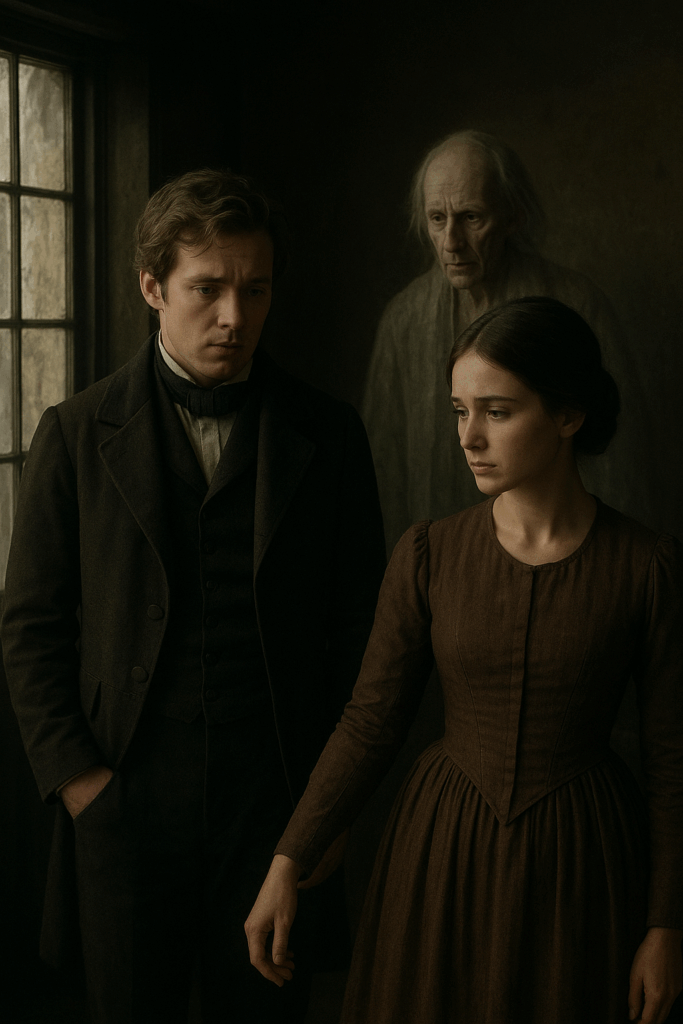
Artwork: The Cost of Gold

Artistic and Interpretative Analysis
1. Composition and Visual Structure

The composition centers on a triangular emotional dynamic:

  • Foreground: Younger Scrooge and Belle, positioned close but emotionally distant.

  • Mid-ground: Negative space between them creates a literal and symbolic “gap,” visually capturing the emotional separation caused by Scrooge’s growing love of money.

  • Background: Older Scrooge appear behind them, slightly elevated and softened, functioning almost like a haunting memory.

This layered structure mirrors Dickens’s narrative architecture: the past event in front, the reflective figures behind.


2. Lighting & Mood

The image uses soft, diffused, low-contrast light reminiscent of Dutch Golden Age painting, which evokes:

  • Melancholy and introspection

  • Emotional realism and tenderness

  • A sense of time suspended

Light falls most clearly on Belle’s face, symbolizing her moral clarity and emotional truth. Younger Scrooge is lit more dimly, his features half in shadow, reinforcing his spiritual confusion.

Older Scrooge is even more dimly lit—almost swallowed by the darkness of regret.


3. Emotional Expression

The emotional arc is incredibly clear:

  • Younger Scrooge: His expression is subtly conflicted—more puzzled or defensive than devastated. This aligns with Dickens’s portrayal of a man becoming hardened but not yet aware of it.

  • Belle: Her downcast eyes and sorrowful calm portray a woman who has accepted heartbreak before it even happens. She embodies resignation, not anger.

  • Older Scrooge: His expression is deeply stricken—eyes heavy, mouth tense, posture slightly collapsed. He watches the scene with devastating awareness. His face becomes the emotional climax of the piece.


4. Symbolism

Several symbolic elements emerge:

  • The shadows: Represent the spiritual darkness overtaking younger Scrooge.

  • The physical distance between Belle and younger Scrooge: The emotional gulf of priorities.

  • Older Scrooge behind them: Memory and judgment—echoes of the past that illuminate the present.

  • Belle walking away: Freedom, purity, and the life Scrooge could have chosen.

  • Older Scrooge’s posture: Remorse embodied.


5. Narrative Effectiveness

The image perfectly captures Dickens’s intention in the Belle breakup scene:

  • The tragedy lies not just in the moment itself but in the retrospective understanding.

  • Younger Scrooge’s limited emotional awareness deepens the sorrow.

  • Belle’s quiet heartbreak is dignified, never melodramatic.

  • Older Scrooge’s anguish becomes the emotional anchor, as Dickens intended in Stave Two.

O Come, O Come Immanuel
Latin Hymn, 12th century
Translated by John M. Neale (1818-1866)

O Come, O Come Immanuel
Latin Hymn, 12th century
Translated by John M. Neale (1818-1866)

Playlist Daily Highlight

We’ve provided multiple versions of this classic Christmas carol. Listen to your favorite style, but also try something new!


See if you find a new appreciation for this song or a different version than what you’re used to.


Take the time to listen . . . really listen to the words of this song and reflect on them. Let God speak to you in this moment.