Memory & Mercy

“He wept to see his poor forgotten self as he used to be.”

(A Christmas Carol, Stave 2)


“The true light that gives light to everyone was coming into the world.” 

(John 1.9)


“He heals the brokenhearted and binds up their wounds” (Psalm 147:3)

Advent Day 7: Memory & Mercy

(Theme: Peace — “The Ghost of Christmas Past”)


In Charles Dickens’ A Christmas Carol, the Ghost of Christmas Past arrives to take Scrooge on a journey backward — through the long-forgotten corridors of his own life. The Spirit declares, “I am the Ghost of Christmas Past.” He beckons Scrooge to rise and walk with him, and in doing so, forces him to confront what he has long suppressed. Dickens describes the Spirit’s light — that strange, flickering flame from the top of its head — as if it might be “extinguished” by Scrooge, who even tries to snuff it out with its cap. But the light persists.


That small but significant image tells the truth about us all: the light of truth and mercy cannot be extinguished, even by our denial. The Spirit shines light on the memories Scrooge would rather keep hidden — his lonely boyhood, the warmth of Fezziwig’s generosity, and the heartbreak of losing Belle to his love of gold. Each scene cuts deep, but the purpose is not to condemn Scrooge; it is to redeem him. Memory, painful as it is, becomes the doorway to mercy.


In much the same way, the Spirit of God illuminates our past — not to shame us, but to heal us. Through the prophet Isaiah, the Lord said, “Come now, let us reason together. Though your sins are like scarlet, they shall be as white as snow” (Isaiah 1:18). The Holy Spirit invites us to walk back through our own yesterdays — to acknowledge the moments of selfishness, neglect, or pride — and to see them not as tombstones of failure, but as testimonies of grace.


Scrooge’s journey with the Ghost of Christmas Past reminds us that peace does not come from forgetting, but from remembering rightly — remembering through the lens of mercy. When we allow the Lord to shine His light into our past, He transforms regret into redemption and shame into song. The psalmist writes, “He heals the brokenhearted and binds up their wounds” (Psalm 147:3).


As the Advent season continues, let the light of Christ search your heart. Do not fear the gentle hand of the Spirit who leads you through memory’s door. What past hurt or failure might He want to heal this year? What regret might He be ready to redeem?


When Scrooge finally yields, Dickens tells us that he “wept to see his poor forgotten self as he used to be.” In those tears, peace begins to take root — the peace that comes when mercy meets memory.


This week, we light the candle of Peace, remembering that Christ, the Light of the World, shines into every dark corner of our story. The past no longer holds us captive when it is held in the hands of a merciful Savior.

“The true light that gives light to everyone was coming into the world.” — John 1:9


Let His light shine. Let His mercy heal. And let His peace reign.
Prayer

Merciful Lord, You are the Light that shines in my darkness. As Your Spirit searches the hidden places of my heart, help me to remember my past with honesty and hope. Redeem what is broken, heal what is wounded, and restore what was lost. Thank You that Your mercy is greater than my regret and that Your peace is deeper than my shame. Help me to walk forward in the light of Your forgiveness, free and at peace through Jesus Christ my Lord. Amen.

A Memory of Forgotten Sorrows


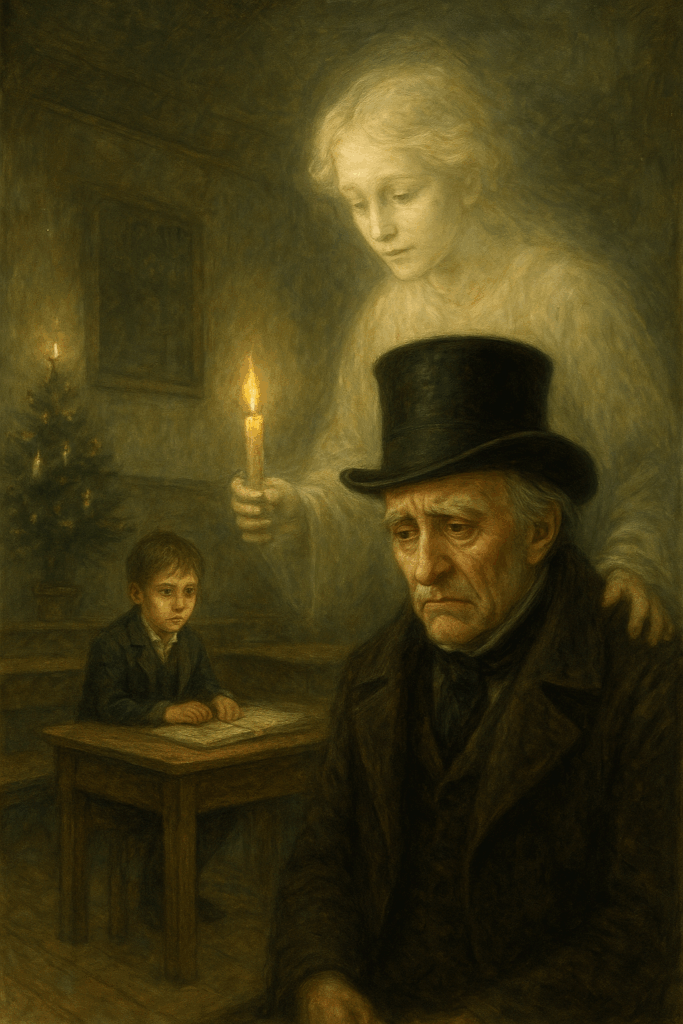
The painting evokes a deeply atmospheric and emotionally charged moment from Stave Two of Dickens’s A Christmas Carol. Its mood is dominated by sorrow, nostalgia, and haunting illumination. The artist appears to intentionally blend realism with a soft, dreamlike haze, emphasizing memory, regret, and the supernatural.

Composition

The composition is triangular:

  • Foreground Right: Older Scrooge—slumped, heartbroken, occupying the darkest area.

  • Center/Upper: The Ghost of Christmas Past—hovering behind him with gentle luminosity.

  • Background Left: Young Scrooge—isolated at a school desk, positioned distantly to underscore emotional and physical separation.

This triangular layout directs the viewer’s gaze from sorrow (older Scrooge), to supernatural guidance (the Ghost), to memory (young Scrooge). The layered spacing helps tell the narrative through visual distance.


Use of Light

Light is the most symbolic component:

  • The ghost’s candle provides the main illumination, casting a warm, almost sacred glow.

  • The ghost’s figure appears semi-translucent, blending with the light—suggesting purity, otherworldliness, and a connection between past and present.

  • Scrooge’s face is lit from above, highlighting every wrinkle, conveying regret and inner turmoil.

  • Young Scrooge sits in a dimmer pool of light, evoking deprivation, loneliness, and emotional coldness despite the season.

The lighting acts not only as an aesthetic tool but as symbolic storytelling—light revealing truth, memory, and the painful illumination of past wounds.


Emotion and Expression

The emotional heart of the painting is older Scrooge’s face:

  • His expression is rendered with realist detail—drooping eyes, deepened jowls, tightened lips.

  • He looks downward, not at the child—suggesting shame and grief rather than simple observation.

  • The Ghost’s hand resting on him adds tenderness and contrasts Scrooge’s rigidity with the spirit’s compassion.

  • Young Scrooge appears stiff, withdrawn, absorbed in solitude, embodying abandonment.

Together, the expressions form an emotional narrative of regret, empathy, and lost childhood.


Symbolism

Several symbolic elements appear subtly:

  • The candle: Truth, revelation, the “light that shines into Scrooge’s darkness.”

  • The small Christmas tree in the background: A symbol of festivity—ironically placed near a child who does not feel its warmth.

  • The desk: Represents education, discipline, and also the emotional neglect intertwined with Scrooge’s upbringing.

  • The ghost’s ethereal form: A liminal presence bridging the spiritual and earthly worlds.

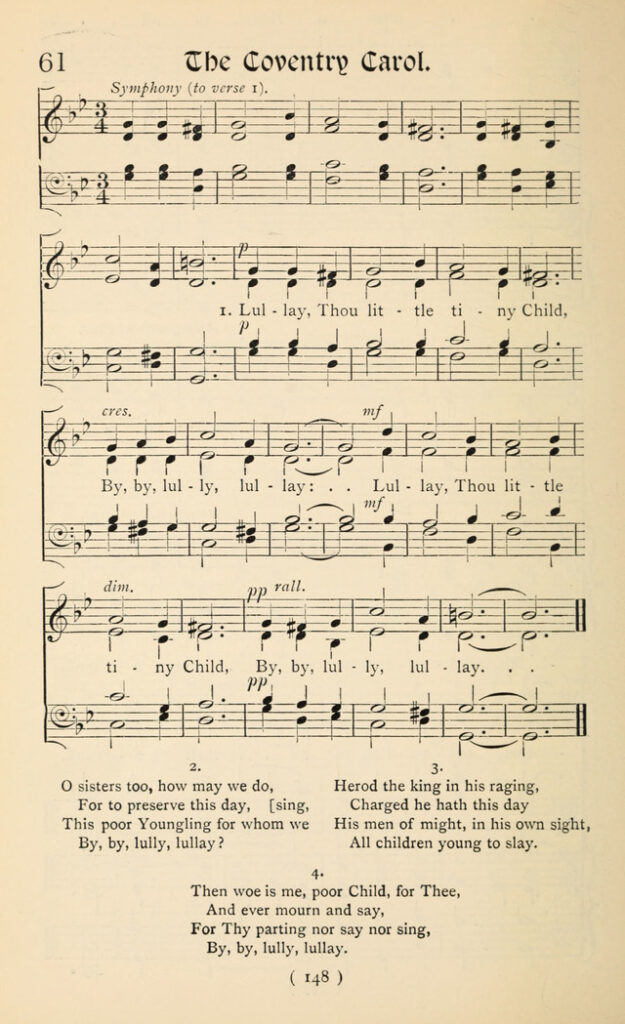
Coventry Carol (orig. Lullay Tiny Little Child)

1534

Written by Robert Croo

Coventry Carol (orig. Lullay Tiny Little Child)

1534

Written by Robert Croo

Playlist Daily Highlight

We’ve provided multiple versions of this classic Christmas carol. Listen to your favorite style, but also try something new!


See if you find a new appreciation for this song or a different version than what you’re used to.


Take the time to listen . . . really listen to the words of this song and reflect on them. Let God speak to you in this moment.