Scrooge: Miserable and Miserly

“Oh! But he was a tight-fisted hand at the grindstone, Scrooge!  A squeezing, wrenching, grasping, scraping, clutching, covetous old sinner!”  (A Christmas Carol, Stave 1)


“If anyone has material possessions and sees a brother or sister in need but has no pity on them,
how can the love of God be in that person?”

(1 John 3.17)

Advent Day 2 — Scrooge: Miserable and Miserly

Theme: The emptiness of a life apart from love; the ache that hope can heal.


Scrooge is a miserable, cold, heartless, and unkind man; completely lacking in joy, warmth, compassion, and charity.


He has made a name for himself and is well-respected in the financial world. He made his fortune through his counting house as a banker and money changer. Yet, despite his immense wealth, Scrooge is bankrupt in a parallel economy. An economy not measured in British pounds, French francs, or American dollars. It is a spiritual economy measured in love, generosity, and benevolence.


Scrooge, despite his vast fortune, is bankrupt spiritually. His miserable demeanor is a symptom of his spiritual reality . . . he is dead.  The opening words of the novella, “Marley was dead, to begin with” sets the tone, for Marley and Scrooge are essentially the same man. “Sometimes people new to the business called Scrooge ‘Scrooge,’ and sometimes ‘Marley,’ but he answered to both names. It was all the same to him.” Both Marley and Scrooge are dead. Scrooge just doesn’t know it, yet.


Like Scrooge, we are all tempted to clutch relentlessly to our possessions, our bank accounts, our status . . . the things that give us a false sense of security and purpose. But seeking joy, peace, or meaning in these is inefficacious.


As Christians, God has called us to cling to the things of the Heavenly realm and eschew the things of this world. In Matthew 6.19-21, Jesus exhorts his disciples to store up their treasures in heaven rather than on earth. In Matthew 6.38, Jesus tells his disciples to be generous in giving to others. Proverbs 14.21 teaches that it is a sin to despise your neighbor, but you will be blessed for being kind to someone in need. The life of the follower of Jesus ought to be defined by love, charity, kindness, and self-sacrifice.


In this Christmas season, find ways to demonstrate kindness and benevolence to those in need. As a family, discuss what that might look like and then together . . . do it!


Prayer

Gracious Father, I thank you for your generosity in my life. Thank you for life and for sustenance that you provide. Please forgive me for times of ingratitude or forgetfulness of the source of my successes.


Help me to be generous to those in need. Help me to see people, as you see them; to have compassion on those that are hurting and in need. Help me to live a life of charity, generosity, and kindness. Help me to find my identity, purpose, and joy in loving you through loving and helping others.

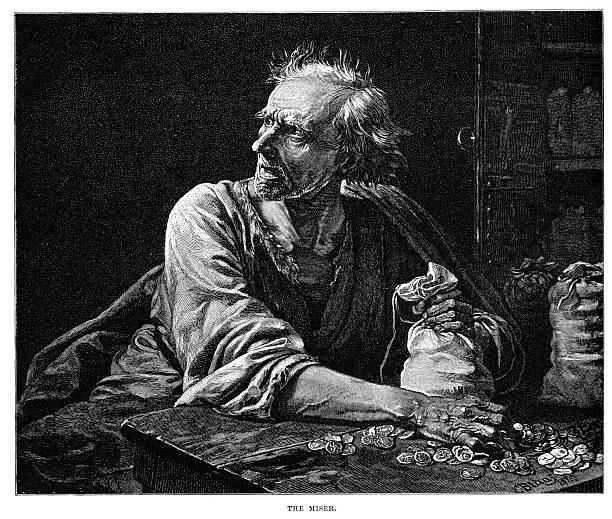
“The Miser” by unknown artist

Wood engraving after a painting by Austrian artist Eugene von Blaas @1885-1896. 

Artistic and Interpretative Analysis
  • Subject and Composition: The engraving focuses intensely on a single, aged figure, hunched over a table overflowing with gold coins and money bags. The lighting is dramatic, highlighting his gaunt face, scraggly hair, and grasping hands, which emphasizes his obsessive relationship with his wealth. The barred window in the background suggests he is locked away with his treasure, either for security or self-imposed isolation, reinforcing themes of secrecy and a life devoid of human connection.
  • Symbolism of Avarice: The figure is an archetypal “miser” or “Ebenezer Scrooge” figure, serving as a powerful visual metaphor for the sin of greed and the love of money. Art in this period often used such figures to explore moral lessons about wealth, poverty, and redemption, a notable example being Charles Dickens’ A Christmas Carol. The character represents someone who values material possessions over all else, a vice that was frequently critiqued in 19th-century literature and art.
  • Victorian Context: The work likely reflects broader societal concerns about the accumulation of wealth and the contrast between the “deserving” and “undeserving” poor that were prevalent in Victorian society. The image serves as a moral warning, illustrating the psychological and spiritual poverty that accompanies extreme material greed. The man’s fearful and anxious expression as he guards his money suggests that his wealth brings him not happiness or security, but a life of paranoia and isolation.

12 Days of Christmas
1780 English Carol (published; older)

12 Days of Christmas
1780 English Carol (published; older)

Playlist Daily Highlight

We’ve provided multiple versions of this classic Christmas carol. Listen to your favorite style, but also try something new!


See if you find a new appreciation for this song or a different version than what you’re used to.


Take the time to listen . . . really listen to the words of this song and reflect on them. Let God speak to you in this moment.