Reconciliation: Making Things Right

“A merrier Christmas, Bob, my good fellow, than I have given you for many a year! I’ll raise your salary, and endeavor to assist your struggling family!”

(Scrooge, A Christmas Carol, Stave 5)


“Therefore, if you are offering your gift at the altar and there remember that your brother or sister has something against you, leave your gift there in front of the altar. First go and be reconciled to them; then come and offer your gift.” (Matthew 5:23–24)

Advent Day 19 — Reconciliation: Making Things Right

Theme: Love restores what sin has broken


The dawn has broken, and Scrooge—newly alive in heart and spirit—bursts into the streets with laughter. But his transformation doesn’t stop with joy; it moves outward in love. The man who once shut himself away now hurries to make things right.


He sends a grand turkey to the Cratchits. He surprises Fred and his wife at their Christmas feast. And when he walks into his office the next morning, his kindness toward Bob Cratchit leaves the humble clerk utterly astonished.

“A merrier Christmas, Bob, my good fellow, than I have given you for many a year! I’ll raise your salary, and endeavor to assist your struggling family!”

Scrooge doesn’t merely feel different—he acts different. His repentance bears fruit in reconciliation.


That’s the power of divine love. It does not stay private or hidden in the heart. True love moves toward others, restoring what sin has broken, healing what pride has wounded. As Jesus taught in Matthew 5, love compels us to go and make things right before we come to worship. Reconciliation, in God’s kingdom, is worship.


Scrooge’s transformation mirrors the gospel truth that grace always overflows. When God changes us, the love He plants within us cannot stay confined. It spills over into generosity, forgiveness, and compassion.


This is the message of the fourth Advent candle—the Candle of Love. Love is the fulfillment of Advent’s hope, peace, and joy. It is both the evidence and the expression of a redeemed heart.


As you reflect today, ask: Where might God be calling me to make things right? Is there a relationship in need of healing, a word of apology left unspoken, or an act of kindness waiting to be offered?


Spend time with today’s curated artwork, a tender depiction of Scrooge’s reunion with Fred and his family—a visual echo of reconciliation’s warmth. Then, listen to the Advent Playlist selections for this day—songs of restoration and love, such as “Love Came Down at Christmas” and “O Holy Night.” Let their beauty soften your spirit and move you toward peace with others.

Prayer

God of Love and Restoration, thank You for reconciling me to Yourself through Christ. Where I have wounded others, give me courage to seek forgiveness. Where I have harbored resentment, teach me to let it go. Fill my heart with Your love, so that I may extend it freely to those around me. Make my life a living testimony to Your grace—a story of reconciliation written by Your hand. In the name of Jesus, who makes all things right, Amen.

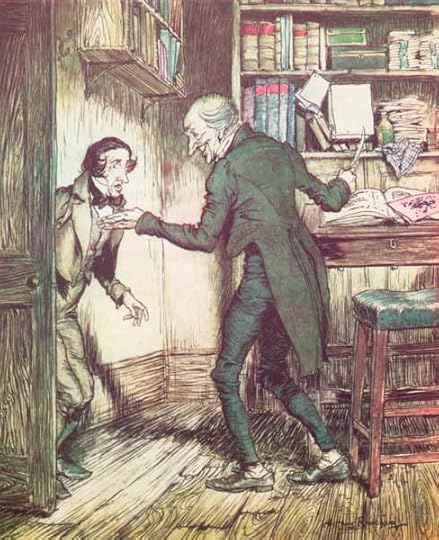
Artwork: Scrooge and Bob Cratchit
Artist: Arthur Rackham
Medium: Hand-drawn with watercolor washing
Date: 1915
Published in: A Christmas Carol by Charles Dickens

Artistic Analysis

This illustration depicts Ebenezer Scrooge joyfully confronting Bob Cratchit the morning after Scrooge’s transformation in A Christmas Carol. The style—expressive lines, earthy colors, exaggerated facial features, and lively movement—strongly resembles the work of Arthur Rackham, one of the most influential illustrators of the early 20th century. Whether or not this specific image is Rackham’s, it clearly stands within his artistic tradition.

1. Composition & Staging

The illustration creates a dynamic triangular movement:

  • Scrooge, positioned at the center-right, leans forward with animated energy.

  • Cratchit, entering from the left, recoils in surprise and confusion.

  • The cluttered desk and shelves behind Scrooge complete the triangular frame.

This composition reinforces the emotional contrast between the two characters:

  • Scrooge’s explosive joy and eagerness dominate the scene.

  • Cratchit’s timid, startled posture places the viewer in his shoes—unsure what to make of Scrooge’s strange behavior.

The doorway acts like a threshold between the old world and the new, with Cratchit literally stepping into Scrooge’s reinvention.

2. Use of Line, Color & Style

The image employs:

  • Loose, energetic linework giving a sense of motion and vitality.

  • Earth-toned color washes—greens, browns, yellows—that evoke a warm, old-world atmosphere.

  • Angular and exaggerated forms, especially in the characters’ limbs and faces, creating a whimsical, almost caricature-like quality typical of Rackham’s storytelling approach.

These stylistic choices underscore the comedic shock of Scrooge’s transformation. His joyful manner is so exaggerated that it almost appears absurd—inviting the viewer to share Cratchit’s disbelief.

3. Character Rendering & Emotion

Scrooge:

  • His body leans enthusiastically toward Cratchit, almost invading his personal space.

  • His face is alive with warmth, amusement, and anticipation.

  • His raised hand and bent posture convey a childlike excitement.

This is Scrooge in the fullness of his redemption—overflowing with generosity, kindness, and delight.

Cratchit:

  • He shrinks back, clutching his hat and scarf.

  • His eyes are wide, and his mouth is slightly open, signaling shock and confusion.

  • His body language suggests he expects reprimand or dismissal—not joy.

Cratchit’s reaction beautifully highlights the radical nature of Scrooge’s change.

4. Setting & Symbolism

The office, though cramped and cluttered, becomes a stage for transformation:

  • Open books symbolize Scrooge’s new openness and willingness to change.

  • Shelves stacked with papers and ledgers remind the viewer of Scrooge’s former obsession with business and money.

  • Warm wooden tones suggest a shift from the coldness associated with Scrooge earlier in the story.

The disarray of the room parallels the disarray Scrooge feels as he bursts into this new life—joyful, impulsive, even a little chaotic.

5. Movement & Energy

The illustration is full of movement:

  • Scrooge leans forward mid-sentence.

  • Cratchit recoils backward.

  • Pages flip or hang from the desk.

  • The lines themselves feel restless and alive.

This motion mirrors the narrative moment—Scrooge is no longer static, cold, or closed off. He is in motion toward others, toward life, toward generosity.

6. Mood & Theme

The mood is warm, comedic, and deeply human. The illustration captures the story’s central theme: transformation that expresses itself in relational joy.

It is a moment of grace, restoration, and humorous surprise. The viewer is invited to laugh along with Scrooge’s exuberance and Cratchit’s bewilderment.


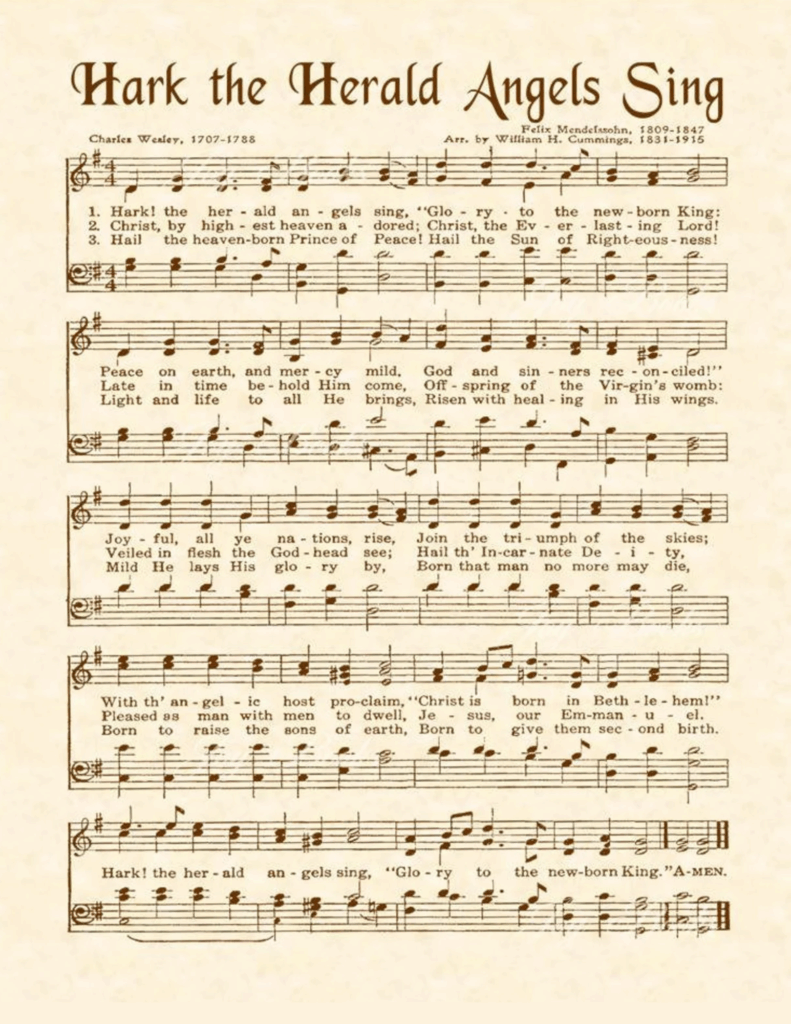
Hark the Herald Angels Sing
Hymn, 1739
Written by Charles Wesley (1707-1788)

Modified by George Whitfield (1714-1770), 1753


Tune: Felix Mendelssohn
German national tune commemorating 400th anniversary of Gutenberg’s printing press, 1840

O Come, O Come Immanuel
Latin Hymn, 12th century
Translated by John M. Neale (1818-1866)

Playlist Daily Highlight

We’ve provided multiple versions of this classic Christmas carol. Listen to your favorite style, but also try something new!


See if you find a new appreciation for this song or a different version than what you’re used to.


Take the time to listen . . . really listen to the words of this song and reflect on them. Let God speak to you in this moment.