Ignorance and Want
Seeing the world's needs through Christ's eyes
“This boy is Ignorance. This girl is Want. Beware them both.” (A Christmas Carol, Stave 3)
“Whatever you did for one of the least of these brothers and sisters of mine, you did for me.” (Matthew 25:40)
“The Spirit of the Lord is upon me… He has anointed me to proclaim good news to the poor.” (Luke 4:18)
“If anyone has material possessions and sees a brother or sister in need but has no pity on them, how can the love of God be in that person?” (1 John 3:17)
Advent Day 13: Ignorance and Want — Seeing the World’s Need Through Christ’s Eyes
(Theme: Compassion — The Call to See and Serve)
As the Ghost of Christmas Present’s time draws near its end, Dickens takes us to one of the most haunting moments in A Christmas Carol. From beneath the Spirit’s robe, two ragged, starving children emerge — a boy and a girl. Dickens writes:
“They were a boy and girl. Yellow, meagre, ragged, scowling, wolfish; but prostrate, too, in their humility.”
The Spirit declares, “This boy is Ignorance. This girl is Want. Beware them both, and all of their degree, but most of all beware this boy, for on his brow I see that written which is Doom, unless the writing be erased.”
These two spectral children embody the deep brokenness of humanity — the suffering that greed and indifference breed. Ignorance blinds us to truth; Want hardens us against compassion. Dickens’ warning rings like a prophet’s cry: a society (or a soul) that ignores the poor and uneducated, that turns away from suffering, will face its own destruction.
The Ghost’s revelation mirrors the heart of Scripture. In Matthew 25, Jesus identifies Himself with “the least of these” — the hungry, the thirsty, the stranger, the naked, the sick, and the imprisoned. “Truly I tell you,” He says, “whatever you did for one of the least of these brothers and sisters of mine, you did for me.” (Matthew 25:40). To look upon suffering with compassion is to look upon Christ Himself.
Scrooge recoils in horror at the sight of the children. But that moment is crucial — he sees. His eyes, long closed to the world’s need, begin to open. Likewise, Advent calls us to see — not to avert our gaze from the pain, poverty, and injustice in our world, but to look upon it through the compassionate eyes of Christ.
Christmas is not only about a cradle in Bethlehem, but also a cross at Calvary — the place where God Himself entered into the world’s Want and Ignorance to redeem it. The Incarnation means that God did not turn away from our poverty; He stepped into it.
This Advent season, may we remember that to celebrate Christ’s coming is to embrace His mission — to love the broken, to lift the fallen, and to bring light where darkness reigns.

Prayer
Lord Jesus, open my eyes to see the world as You see it. Break my heart for what breaks Yours. Forgive me when I turn away from the needs around me. Teach me to serve the poor, to love the lost, and to act with compassion in Your name. May my hands bring comfort, my words bring hope, and my life reflect Your heart of mercy. This Advent, help me to see You in the faces of those who need You most. Amen.
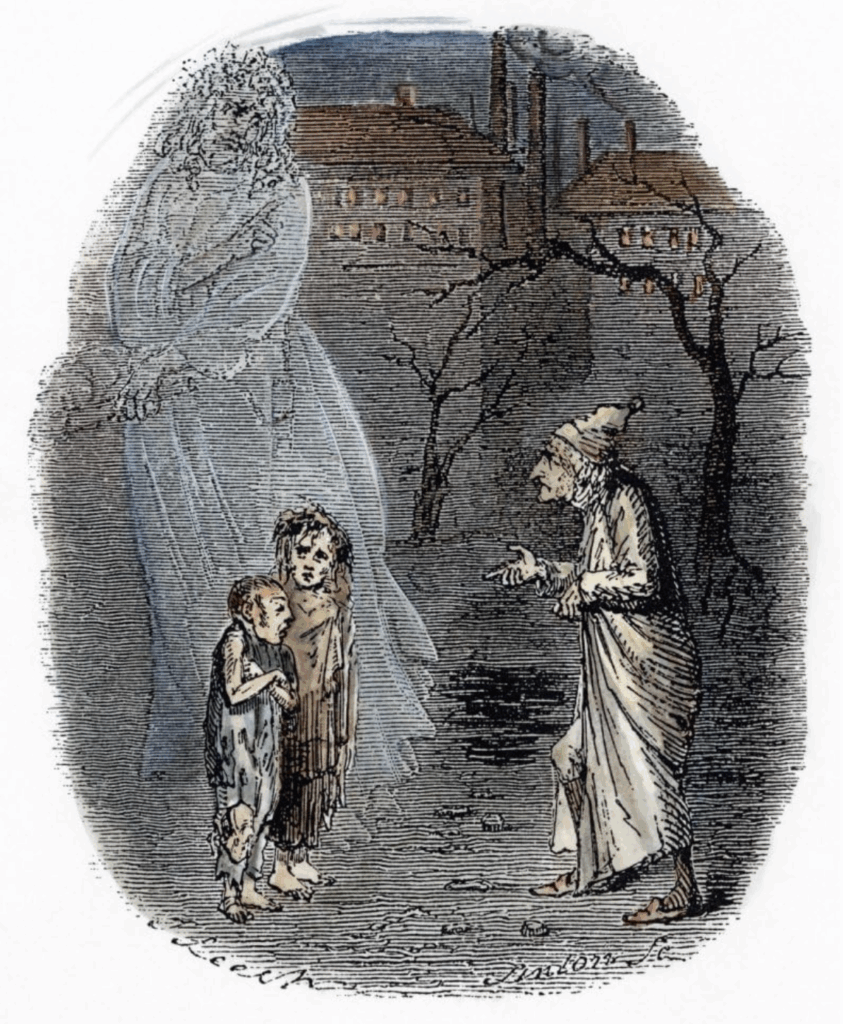
Artwork: Ignorance & Want
Artist: John Leech
Medium: Hand-colored etching
Date: 1843
Published in: A Christmas Carol by Charles Dickens
Artistic Analysis
1. Subject and Narrative Context
This illustration shows the dramatic moment in Stave Three when the Ghost of Christmas Present reveals the two spectral children hidden beneath his robe: Ignorance (the boy) and Want (the girl). This is Dickens’s most explicit social indictment in the story—a moral warning about poverty, societal neglect, and the consequences of indifference.
In the image:
The Ghost of Christmas Present stands large, ghostly, and sorrowful.
Ignorance and Want, ragged and malnourished, stand before Scrooge.
Scrooge, visibly shaken, bends forward in horror and concern.
The moment is both allegorical and deeply political, capturing Dickens’s message about Victorian society’s failures.
2. Composition
Leech uses strong vertical contrast between the towering, ethereal Ghost and the small, suffering children. This creates a hierarchy:
Top / Background
The Ghost stands almost as a protective but powerless figure.
Smokestacks and bleak industrial buildings loom in the background, representing the harshness of industrial-era poverty.
Center
Ignorance and Want are the emotional and symbolic core.
Their huddled forms draw the eye and anchor the composition.
Bottom / Foreground
Scrooge, hunched and fearful, engages directly with the children.
This triangular arrangement reinforces the allegory: society (Scrooge) must face the consequences (the children) revealed by moral truth (the Ghost).
3. Emotional and Symbolic Presentation
The Children
Ignorance, the boy, is shown with a more aggressive, more threatening expression, as Dickens intended. He represents moral and educational neglect.
Want, the girl, appears frail, ashamed, and sickly, representing physical deprivation.
Their bare feet, tattered clothes, and hollow eyes communicate both suffering and warning.
The Ghost
He is massive yet sorrowful, his transparency highlighting his supernatural role. His expression is one of pity and urgency. The Ghost serves as a moral judge, revealing truths Scrooge must confront.
Scrooge
He leans forward, tentative and disturbed. His body language conveys:
fear
dawning understanding
a moral awakening in progress
This is one of the moments where Scrooge’s transformation rapidly accelerates.
4. Setting and Background Symbolism
The background is not random. It includes:
Industrial buildings with chimneys, representing factories, child labor, and urban poverty.
Bare trees, signifying the barrenness of society’s compassion.
A muddy or uneven ground, creating a sense of instability and moral degradation.
This setting situates the allegory within Dickens’s social critique of industrial capitalism and Victorian neglect of the poor.
5. Overall Interpretation
This illustration stands out as one of the most powerful in A Christmas Carol. It blends:
social realism
moral allegory
Victorian engraving aesthetics
emotional intensity
Leech translates Dickens’s indictment of societal neglect into a vivid, unsettling tableau that remains as striking today as it was in 1843.
The image not only supports the text—it amplifies Dickens’s call for compassion, education, and societal reform.
O Come, O Come Immanuel
Latin Hymn, 12th century
Translated by John M. Neale (1818-1866)
O Come, O Come Immanuel
Latin Hymn, 12th century
Translated by John M. Neale (1818-1866)
Playlist Daily Highlight
We’ve provided multiple versions of this classic Christmas carol. Listen to your favorite style, but also try something new!
See if you find a new appreciation for this song or a different version than what you’re used to.
Take the time to listen . . . really listen to the words of this song and reflect on them. Let God speak to you in this moment.