Bob Cratchit - The Humble & the Blessed
“There never was such a goose. Bob said he didn’t believe there ever was such a goose cooked. Its tenderness and flavour, size and cheapness, were the themes of universal admiration. Eked out by the apple-sauce and mashed potatoes, it was a sufficient dinner for the whole family. . . . ‘Oh, a wonderful pudding!’ Bob Cratchit said, and calmly too, that he regarded it as the greatest success achieved by Mrs. Cratchit since their marriage, Mrs. Cratchit said that now the weight was off her mind, she would confess she had had her doubts about the quantity of flour. Everybody had something to say about it, but nobody said or thought it was at all a small pudding for a large family. It would have been flat heresy to do so. Any Cratchit would have blushed to hint at such a thing.”
(A Christmas Carol, Stave 3)
“I have learned to be content whatever the circumstances.” (Philippians 4:11)
“Blessed are the poor in spirit,
for theirs is the kingdom of heaven. Blessed are those who mourn, for they will be comforted. Blessed are the meek, for they will inherit the earth. Blessed are those who hunger and thirst for righteousness, for they will be filled. Blessed are the merciful, for they will be shown mercy. Blessed are the pure in heart, for they will see God. Blessed are the peacemakers, for they will be called children of God.”
(Matthew 5:3-9)
Advent Day 10: Bob Cratchit – The Humble & the Blessed
(Theme: Peace — Contentment in Simplicity)
In A Christmas Carol, few characters shine with more warmth and goodness than Bob Cratchit. Despite long hours, meager pay, and the daily chill of Scrooge’s office, Bob maintains a gentle spirit and a heart full of gratitude. Dickens describes him leaving work on Christmas Eve with “fifteen ‘Bob’ a week, and a wife and family, talking about a merry Christmas.” Somehow, joy still finds him.
At home, the Cratchit family celebrates with humble abundance. Their Christmas dinner — a modest goose, potatoes, gravy, and pudding — is made magnificent by their love for one another. Dickens writes, “There never was such a goose. Bob said he didn’t believe there ever was such a goose cooked.” Their feast, though simple, becomes sacred because it is shared. Their laughter fills the small house more richly than any fine furnishings could.
Bob’s life mirrors the words of the apostle Paul: “I have learned to be content whatever the circumstances.” (Philippians 4:11). True peace is not found in wealth, but in worship. The Cratchits remind us that contentment is not about what we have, but about who we have — God’s presence and the people we love.
In Bob’s humility, we see strength. He bears Scrooge’s cruelty with patience, prays for his employer despite injustice, and leads his family in faith. Even when he carries Tiny Tim on his shoulders, he radiates hope. Dickens tells us, “Bob held his withered little hand in his, as if he loved the child and wished to keep him by his side, and dreaded that he might be taken from him.” There is no bitterness in Bob — only tenderness, courage, and gratitude.
The Cratchit home is a picture of Advent peace — the quiet assurance that God is with us even in scarcity, sorrow, or strain. In that small, candle-lit room, love reigns where money never could.

Prayer
Lord of every good gift, teach me the secret of contentment. Help me to find peace not in possessions, but in Your presence. Give me a humble heart like Bob Cratchit’s — grateful, gentle, and generous. May my home, like his, be filled with joy that springs from love and faith. In this Advent season, remind me that the greatest riches are found in Christ alone. Amen.
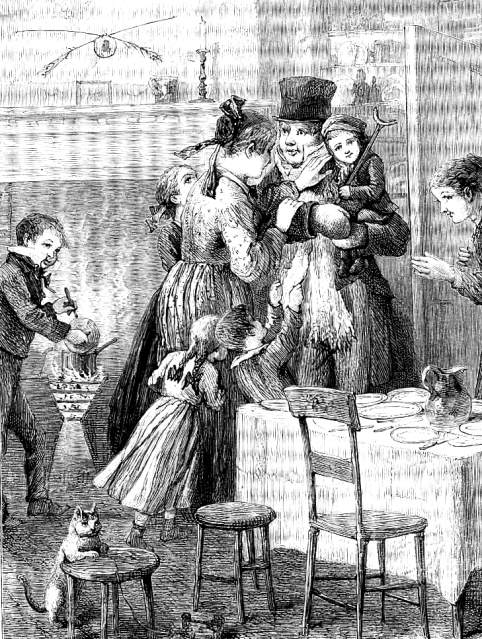
Artwork: Bob Cratchit at Home
Artist: Sol Eytinge
Medium: Wood engraving
Date: 1869
Published in: A Christmas Carol by Charles Dickens (Diamond edition)
Artistic and Interpretative Analysis
1. Subject and Narrative Context
The image captures the heartwarming domestic moment of Bob Cratchit returning home on Christmas Day, greeted affectionately by his wife and children. Tiny Tim sits on Bob’s shoulder, making him the emotional focal point of the composition. This scene is one of Dickens’s most iconic depictions of humble joy within poverty. The illustrator visually reinforces Dickens’s contrast between material lack and emotional abundance.
The illustration conveys:
Family unity
Warmth despite want
Tiny Tim as a symbol of innocence, fragility, and hope
This household embodies the moral core of the novella: true wealth lies in love, not possessions.
2. Composition
The artist uses a tight, crowded composition to emphasize the small quarters of the Cratchit home. Everyone is physically close, which conveys intimacy and limited living space.
Key compositional features:
Bob Cratchit and Tiny Tim at the center, making them the emotional nucleus.
Surrounding family members form a semi-circular embrace around Bob, directing attention inward.
The table, chairs, and small stool create grounding elements that highlight the modesty of their possessions.
The cat in the bottom left adds to the feeling of lived-in domesticity and further softens the scene.
The viewer’s gaze is meant to land first on Bob and Tiny Tim, then follow the family group outward, reinforcing the theme of communal joy.
3. Line Work and Technique
This is a wood engraving or steel engraving, typical of Victorian book illustration.
The dense cross-hatching creates texture and shading, giving depth and detail despite being monochrome.
Lines vary in density to indicate fabric, hair, facial expressions, and the fireplace’s warmth.
The background features softer and more uniform hatching, pushing it visually backward, while characters are rendered with sharper, darker lines to draw focus forward.
The technique is designed not just for aesthetics but also for clarity in print, as engravings needed to hold up well at small sizes in serialized books.
4. Emotion and Gesture
The illustration is packed with expressive gestures:
Bob Cratchit’s smiling face reflects joy at being reunited with his family.
Mrs. Cratchit leans forward eagerly, her body language expressing affection and relief.
Tiny Tim leans against his father, visually reinforcing vulnerability and dependence.
The children—one hugging Bob, another tending to the pudding—capture the bustle and excitement of a poor but loving Christmas.
The cat scratching at a stool adds a lighthearted, naturalistic touch.
The expressions are soft, open, and brimming with affection, underscoring Dickens’s message of familial warmth.
5. Depiction of Poverty
The illustrator subtly communicates the Cratchits’ lower-class status:
Sparse furnishings: a few chairs, a simple table.
A plain hearth without elaborate decoration.
Modest clothing with simple textures.
Tiny Tim’s crutch and frailty emphasize economic and emotional strain.
Despite this, nothing appears grim; the illustrator honors Dickens’s insistence that the Cratchits are poor but not miserable.
6. Symbolism and Themes
Warmth vs. Hardship
The fireplace, although not heavily detailed, implies warmth and security—contrasting sharply with Scrooge’s cold, lonely chambers.
Family as Salvation
The clustering of figures symbolizes the Cratchit family’s strength through unity—this is what Scrooge lacks and what ultimately transforms him.
Tiny Tim’s Importance
Placed high in the composition, close to Bob’s smiling face, Tim is symbolically elevated. His physical weakness gives emotional height to the otherwise small room.
Domestic Virtue
Victorian audiences saw this scene as a moral emblem of piety, humility, and gratitude.
O Come, O Come Immanuel
Latin Hymn, 12th century
Translated by John M. Neale (1818-1866)
O Come, O Come Immanuel
Latin Hymn, 12th century
Translated by John M. Neale (1818-1866)
Playlist Daily Highlight
We’ve provided multiple versions of this classic Christmas carol. Listen to your favorite style, but also try something new!
See if you find a new appreciation for this song or a different version than what you’re used to.
Take the time to listen . . . really listen to the words of this song and reflect on them. Let God speak to you in this moment.