FEZZIWIG'S JOY
Generosity as worship; the spirit of celebration
“The happiness he gives is quite as great as if it cost a fortune.” ~ (A Christmas Carol)
“Glory to God in the highest, and on earth peace, goodwill toward men.” — Luke 2:14
“God loves a cheerful giver.” — 2 Corinthians 9:7

Advent Day 8: Fezziwig’s Joy
(Theme: Peace — “The Gift of Generosity”)
In A Christmas Carol, one of the most heartwarming scenes comes when the Ghost of Christmas Past takes Scrooge to revisit his apprenticeship under the kindly Mr. Fezziwig. Dickens paints the moment vividly — the cheerful bustle of a Christmas Eve party, laughter filling the room, fiddlers tuning up, and the humble office transformed into a ballroom. “Yo ho, my boys!” cries Fezziwig. “No more work tonight! Christmas Eve, Dick! Christmas, Ebenezer!” The joy of Fezziwig’s heart spilled over into every corner of his world.
Scrooge, watching the memory unfold, begins to soften. He realizes what made Fezziwig great was not his wealth but his spirit. Dickens writes, “The happiness he gives is quite as great as if it cost a fortune.” That single line captures a profound truth: generosity is not measured by the size of the gift, but by the size of the heart that gives it.
In the Gospel of Luke, the angels announce, “Glory to God in the highest, and on earth peace, goodwill toward men.” (Luke 2:14). Fezziwig embodies that goodwill — a man whose joyful spirit mirrors the generosity of God Himself. The peace of Christ is not the absence of conflict but the presence of grace and gladness in community. When we give from the abundance of love, we reflect the very heart of God, who “did not spare His own Son, but gave Him up for us all.” (Romans 8:32)
During Advent, we are invited to recover that same spirit — the kind of joy that throws open the doors, turns work into celebration, and blesses others simply because we can. In Scrooge’s remembrance of Fezziwig, the first flicker of transformation appears. His heart, long cold and closed, begins to warm again under the memory of joyful generosity. That is the miracle of grace: it awakens us to what matters most.
As you light the Advent candle of Peace, consider where you might bring joy to others this season. A kind word, a generous gesture, or a cheerful spirit may be the spark that reminds someone else of God’s goodness. True peace often begins in the glow of shared joy.
“The happiness he gives is quite as great as if it cost a fortune.” — Charles Dickens, A Christmas Carol
“Glory to God in the highest, and on earth peace, goodwill toward men.” — Luke 2:14
“God loves a cheerful giver.” — 2 Corinthians 9:7

Prayer
Lord of Joy, thank You for the gift of glad generosity. Teach me to give as You give — freely, cheerfully, and with love that brings peace to others. Help me to be a light of kindness in my family, my church, and my community. May my words and actions reflect Your grace, so that others might glimpse the joy of heaven through my life. In Jesus’ name, Amen.
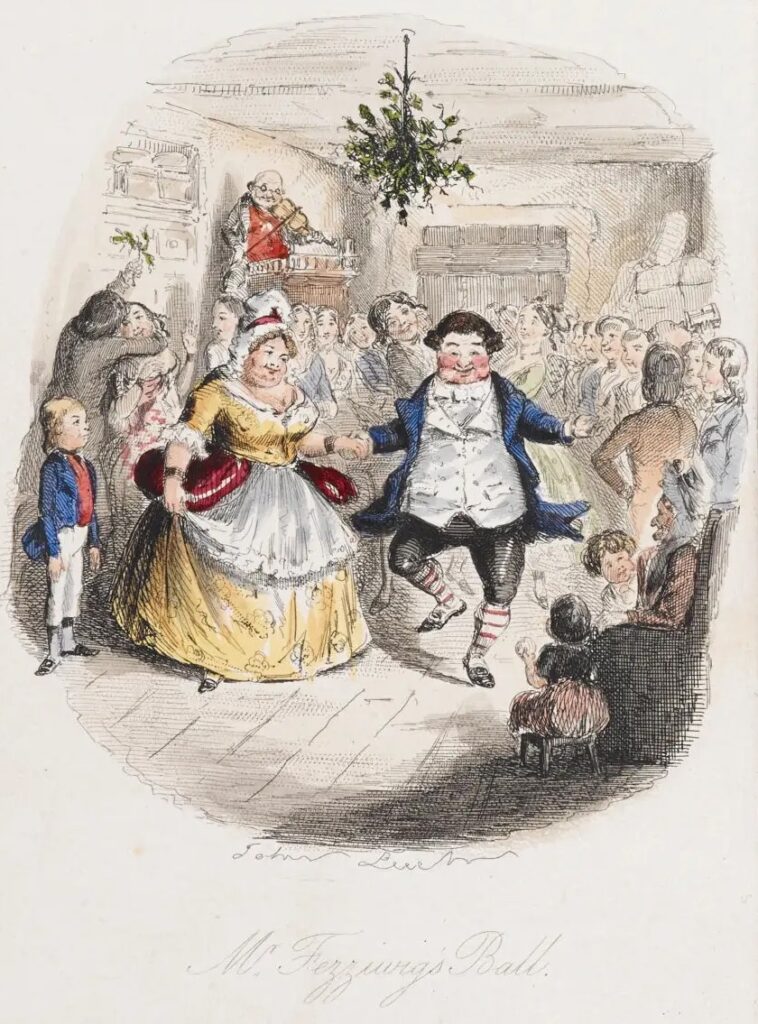
Artwork: Marley’s Ghost
Artist: John Leech
Medium: Hand-colored etching
Date: 1843
Published in: A Christmas Carol by Charles Dickens
Artistic and Interpretative Analysis
1. Context and Purpose
John Leech was commissioned by Dickens to illustrate the first edition of A Christmas Carol. His work blends humor, caricature, and sentiment—perfectly matching Dickens’s tone, which moves swiftly between comedy and moral seriousness.
This particular scene appears during Scrooge’s visit with the Ghost of Christmas Past. It illustrates the warmth and generosity of Scrooge’s first employer, Mr. Fezziwig, serving as a stark contrast to Scrooge’s later cold-hearted business practices.
2. Composition
The composition is lively and circular, radiating outward from the dancing couple—Mr. and Mrs. Fezziwig—who occupy the center foreground. Leech constructs the image so that:
The dancers form the central focal point, symbolizing joy, abundance, and exuberance.
The crowd curves behind them, creating a sense of depth, motion, and festivity.
Children in the foreground and guests in the background guide the eye naturally around the scene, reinforcing the communal atmosphere.
Leech uses the architecture of the warehouse—plain walls, open space—to give the party room to expand visually. The viewer feels swept into the dance.
3. Color and Hand-Tinting
This is one of the few illustrations in the original book that was hand-colored.
Warm yellows, reds, and blues dominate the clothing of the central figures, highlighting their warmth and joviality.
The color contrast between the vivid clothing of Fezziwig and his guests and the more muted, almost sketch-like background emphasizes the emotional warmth over the physical setting.
The coloring is intentionally simple but effective, preserving the charm of a festive print while maintaining Victorian restraint.
The cheerful palette reinforces Dickens’s message: Fezziwig is a man who creates warmth and delight in an otherwise dreary world.
4. Linework and Style
Leech’s style is a mixture of caricature and narrative illustration:
Figures are slightly exaggerated—round faces, rosy cheeks, plump outlines—giving the scene humor and accessibility.
His linework is quick, energetic, and full of motion, mirroring the lively dancing and cheerful bustle.
The illustrator uses lighter, finer pen lines for background figures, ensuring that the central dancers remain the visual anchor.
The overall effect resembles a staged theatrical performance—fitting, given Dickens’s theatrical prose.
5. Depiction of Characters
Mr. Fezziwig
Round, vibrant, red-cheeked, overflowing with cheer.
His movement is exaggerated, almost airborne, symbolizing light-hearted generosity.
His stockings and lifted feet add comic charm—joy literally radiates through him.
Mrs. Fezziwig
Equally round, cheerful, and dancing with enthusiasm.
Her elaborate dress and cap emphasize festivity and hospitality.
The Guests
Smiling, clapping, and crowding around the couple, forming a visual chorus of approval.
Their animated expressions heighten the sense of celebration.
The Children
Positioned lower in the composition.
Their delighted reactions show the intergenerational nature of Fezziwig’s goodness.
Leech uses character exaggeration not to mock but to amplify Dickens’s point: Fezziwig’s joy is generous and contagious.
6. Symbolism
Mistletoe
Hanging above the dancers, the mistletoe symbolizes festivity, tradition, and communal affection—contrasting with the loveless adulthood Scrooge eventually chooses.
The Warehouse Setting
Though simple, it reinforces the message that joy does not depend on wealth. Fezziwig uses his resources not for greed but for the happiness of others.
The Dancing
Symbolizes the generosity and freedom that Fezziwig embodies, opposing the rigid, profit-driven mindset Scrooge later develops.
7. Emotional Tone
The mood is unmistakably warm, comic, and jubilant. This is deliberate:
A Christmas Carol uses emotional contrast to transform Scrooge.
By portraying Fezziwig’s warmth so vividly, Leech helps readers feel the loss of what Scrooge surrendered in pursuit of wealth.
The illustration captures the nostalgia and emotional richness of the memory, making Fezziwig one of the story’s most beloved figures.
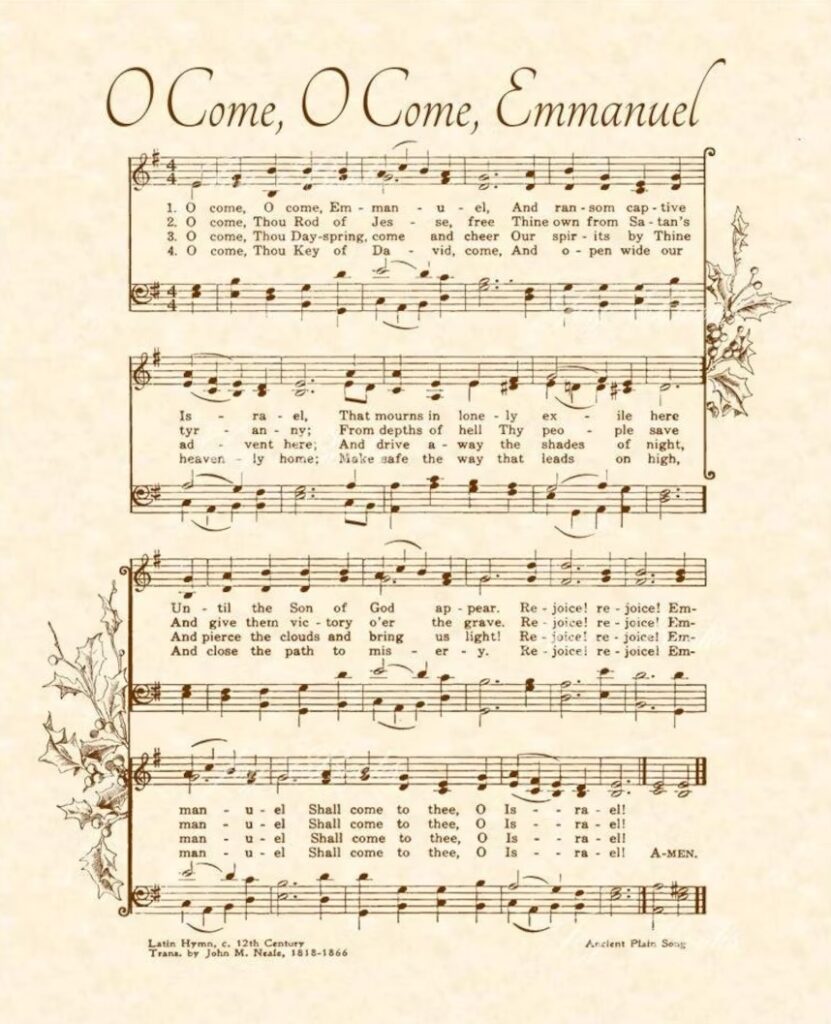
O Come, O Come Immanuel
Latin Hymn, 12th century
Translated by John M. Neale (1818-1866)
O Come, O Come Immanuel
Latin Hymn, 12th century
Translated by John M. Neale (1818-1866)
Playlist Daily Highlight
We’ve provided multiple versions of this classic Christmas carol. Listen to your favorite style, but also try something new!
See if you find a new appreciation for this song or a different version than what you’re used to.
Take the time to listen . . . really listen to the words of this song and reflect on them. Let God speak to you in this moment.