Marley . . . a prophetic message

“I am here to-night to warn you, that you have yet a chance and hope of escaping …” 

(Marley, A Christmas Carol, Stave 1)

“For I know the plans that I have for you,” declares the Lord, “plans for prosperity and not for disaster, to give you a future and a hope. Then you will call upon Me and come and pray to Me, and I will listen to you. And you will seek Me and find Me when you search for Me with all your heart.” 

(Jeremiah 29.11-13)

Advent Day 1 — Marley: A Prophetic Message

Theme: The prophetic voice that awakens hope — conviction as a gift of grace.


In Charles Dickens’, A Christmas Carol, the protagonist is visited by the ghost of his dead business partner, Jacob Marley. Marley calls Scrooge to repent of his heartlessness, materialism and cupidity, and to practice “charity, mercy, forbearance, and benevolence.” Marley hopes that Scrooge may see the error of his ways, repent, and live his life much differently.


The Old Testament is replete with examples of God’s prophets calling God’s people to repentance and to turn back to the God who had rescued them from Egypt and brought them into the Promised Land. 


In both A Christmas Carol and in the Old Testament we see the prophets warning of horrifying things to come in an attempt to get the attention of the wayward . . . Scrooge and the people of Israel. For Scrooge it would be additional, terrifying apparitions bringing their own messages reminding Scrooge of his brokenness and the emptiness of his own attempts to bring meaning to his own life. His own future death and destruction is forewarned.


So, too, the Old Testament prophets reminisced of Israel’s past . . . God’s graciousness and mercy towards them, and their faithlessness towards Him. They demonstrated Israel’s own brokenness and their certain, future destruction . . . unless . . . they heed God’s call to return to Him and exchange their fealty to their false gods for faithfulness to the One true God.


The prophets warned the people of Israel not to count on their own righteousness for salvation, but rather seek God’s righteousness (Jeremiah 23.6). Isaiah foretold of One who would come, a virgin-born Suffering Servant, and bring God’s Kingdom and Peace to all the world (Isaiah 7, 9, 50, 53, et al). The message of this coming Hope was a light pointing forward to the coming of Jesus, the Messiah.


The prophetic impulse of A Christmas Carol is demonstrated throughout the novella, and ultimately, Scrooge embraces the message of hope and peace that comes from living a life of generosity, kindness, and love.


Do you feel God’s Spirit speaking to you? Challenging you? Does the prophetic visit of Marley, Isaiah, etc. get your attention? Don’t mistake this for “an undigested bit of beef, a blot of mustard, a crumb of cheese, a fragment of an underdone potato…” (Don’t mistake the work of God’s Spirit for a bad case of indigestion.) Listen to His message. Yield to His message that he wants to speak to you today and throughout this Advent season.


Week One of Advent is celebrated by lighting the candle of Hope. It’s also called the Prophets candle. The prophets proclaimed the coming of the Messiah and called the people to prepare their hearts for his coming. Isaiah 40.3 says, “A voice of one calling: ‘In the wilderness prepare the way for the Lord; make straight in the desert a highway for our God.’”


Prepare your heart for the message of Hope, Peace, Joy, and Love that comes with the advent of Jesus. Take joy that He has come! Have Hope and Peace that He is coming again! Prepare your heart to truly celebrate this season of Christ-mas!

Prayer

Almighty God, open my ears to hear from you today. Open my eyes to my own shortcomings . . . those parts of my life that are ill-prepared to hear from you; those parts that are hardened to  the moving of Your Spirit. May I not put off Your Spirit as something inconsequential. May I have a Scrooge-Marley experience. A moment that is so clarifying in my life that I know I have encountered a Holy God who calls me to Him. Amen.

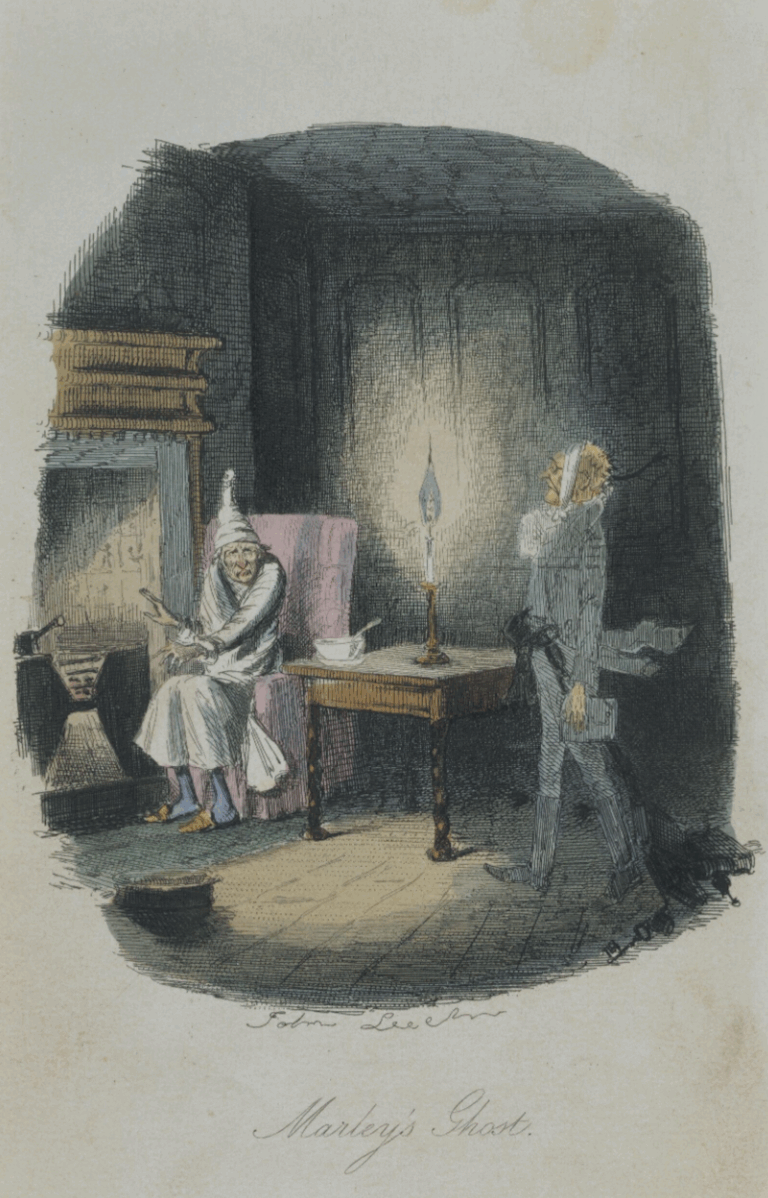
Artwork: Marley’s Ghost
Artist: John Leech
Medium: Hand-colored etching
Date: 1843
Published in: A Christmas Carol by Charles Dickens

Artistic Analysis

This scene visualizes the chilling moment when the ghost of Jacob Marley, bound in heavy chains, appears before Ebenezer Scrooge in his dark, cold chambers. It is the first supernatural visitation in the story — the catalyst for Scrooge’s transformation.


Composition and Setting

Leech places the two figures — Scrooge and Marley’s Ghost — in a tight, shadowed interior that emphasizes confinement and isolation. The light source, a single flickering candle on the table, divides the composition. It casts a dim glow, illuminating the two characters and symbolizing the intrusion of the spiritual world into the material one.

  • Scrooge, huddled in his chair by the fire, is rendered with tense, angular lines. His posture — arms clutched around himself — conveys fear and disbelief.

  • Marley’s Ghost stands upright, transparent yet solid enough to cast a faint shadow. His spectral chains, made of ledgers, cash boxes, and keys, represent the spiritual bondage of greed and earthly materialism.

The table and candle serve as a literal and symbolic barrier between life and death — the living man and the spirit world.


Use of Light and Color

Leech’s use of chiaroscuro (strong contrast between light and dark) amplifies the ghostly tension. The candlelight highlights Scrooge’s pale face and Marley’s semi-transparent form, while the deep shadows engulf the walls, creating a claustrophobic, haunted atmosphere.

The color palette is subdued — mostly gray, black, and brown — with small touches of color:

  • Scrooge’s yellow slippers and the faint pink of his chair add warmth, ironically contrasting his cold demeanor.

  • The blueish-gray tint of Marley’s figure gives him an otherworldly glow, underscoring his spectral nature.


Emotion and Symbolism

This illustration captures the emotional pivot of the story — the confrontation of Scrooge’s rational world with the reality of the supernatural and moral accountability.

  • Scrooge’s fear is not merely of a ghost but of judgment and the realization of what his own soul might become.

  • Marley’s chains symbolize the spiritual consequences of selfishness, while the candle represents truth, revelation, and hope — faint but present even in darkness.


Stylistic Notes

Leech’s style blends Victorian realism with touches of caricature, reflecting Dickens’s own mix of humor and moral seriousness. The slightly exaggerated facial expressions make the moral lesson accessible while keeping the eerie tone intact. His fine linework and controlled crosshatching give the scene depth and texture despite its small scale.


Interpretive Insight

Spiritually, this image dramatizes the moment of awakening and conviction — a kind of visual “judgment scene.” The light piercing the darkness prefigures Scrooge’s redemption. In Christian terms, it’s the moment when conscience and grace first intrude upon a hardened heart

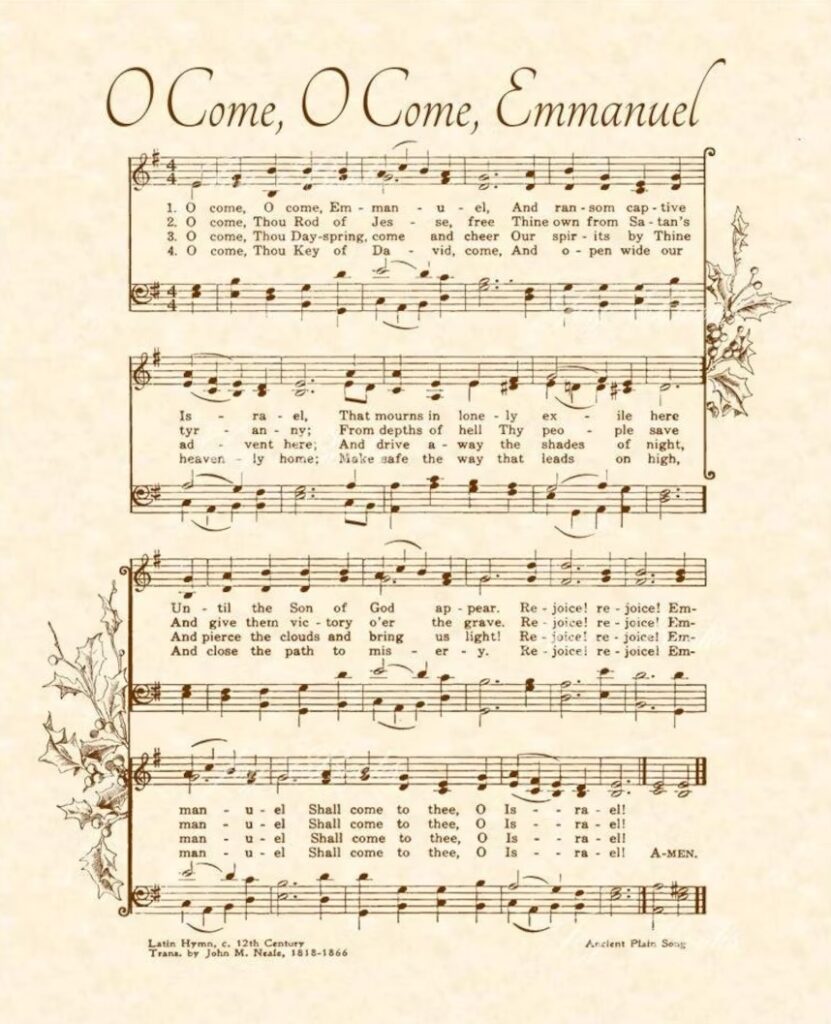
O Come, O Come, Emmanuel
Latin Hymn, 12th century
Translated by John M. Neale (1818-1866)

O Come, O Come Immanuel
Latin Hymn, 12th century
Translated by John M. Neale (1818-1866)

Playlist Daily Highlight

We’ve provided multiple versions of this classic Christmas carol. Listen to your favorite style, but also try something new!


See if you find a new appreciation for this song or a different version than what you’re used to.


Take the time to listen . . . really listen to the words of this song and reflect on them. Let God speak to you in this moment.